


🌟 Engineers — want to meet these three founders and seven others? Apply to attend our March 25th SF Startup Showcase.
Robots work great in demos. Then you put them in someone’s house and a dog runs through the room, or the cup is a different shape, or there’s a spill on the counter that wasn’t in the training data. The gap between “lab demo” and “real world” has killed a lot of robotics companies.
Three companies are working on different pieces of this. Sunday is building home robots. Zipline flies autonomous delivery drones. Specter is building the sensing layer that lets machines understand physical environments. At the core, they’re all building autonomous systems that work outside controlled conditions.
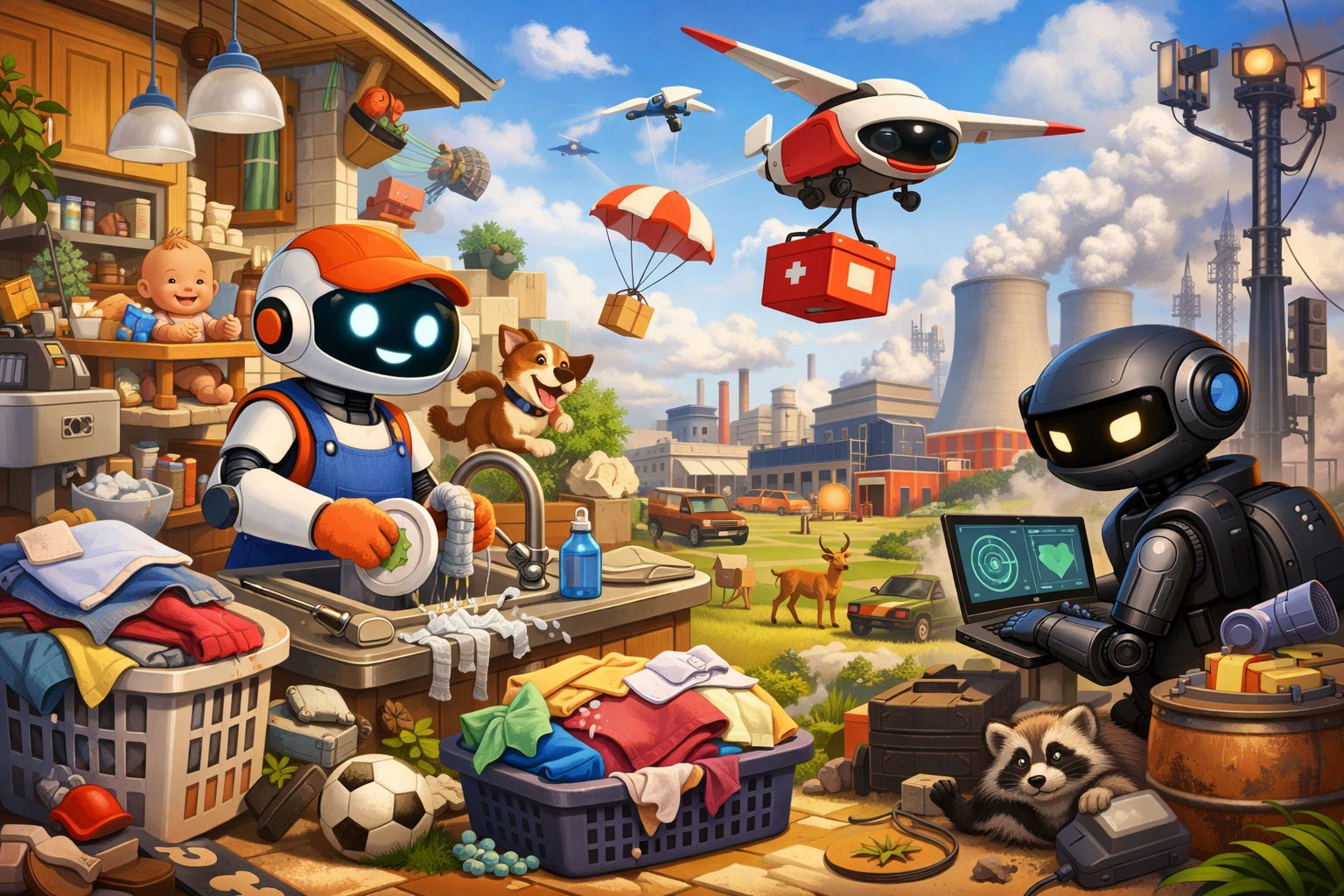
Sunday does the dishes. Zipline flies the deliveries. Specter tries to understand the chaos. The baby, raccoon, and two-tailed dog keep generating new edge cases.
Tony Zhao, founder of Sunday
Tony Zhao spent years in robotics research at Stanford, working with Chelsea Finn and Sergey Levine, with stints at Tesla Autopilot and DeepMind. The pattern was always the same -- a robot learns to pick up a cup in the lab, and then falls apart in a real kitchen with different cups, clutter, and a sequence of tasks. The issue, he realized, wasn’t algorithms. It was data. Robots didn’t have enough real-world examples to learn from, and nobody was collecting them.
In 2024, Zhao and Cheng Chi started Sunday to fix that. They skipped simulation entirely. Instead, they built a wearable “skill capture” glove that records how people actually do household tasks: loading dishwashers, folding laundry, clearing tables. Millions of examples from real homes. Their first robot, Memo, trains on that data to do chores that have resisted automation for decades, mostly because nobody had bothered to collect the training data at scale.
The broader bet is that robotics is hitting the same scaling curve that language models hit a few years ago. Techniques Zhao and Chi developed (diffusion policies, learning from demonstrations) are starting to work well enough to make robots work in the real world. Sunday thinks the home is where people notice first. The engineering is hardware, robot learning, perception, manipulation, data pipelines, and making it all reliable in an environment where someone’s toddler just threw a plate on the floor.
Keenan Wyrobek, founder of Zipline
Keller Rinaudo Cliffton and Keenan Wyrobek didn’t start Zipline to deliver burritos and Amazon packages. Rinaudo had built a smartphone robot company (Romotive); Wyrobek helped create the Robot Operating System (ROS). When they went looking for a problem worth solving, they kept landing on medical logistics in places where roads are bad or nonexistent. A hospital in rural Rwanda runs out of blood, the nearest supply is hours away by truck, and people die waiting. If autonomous flight actually worked, you could deliver that blood in minutes.
Instead of starting in Silicon Valley, they went somewhere harder. In 2016, Zipline launched its first distribution center in Rwanda, building a nationwide system where drones fly medical supplies from centralized hubs to remote clinics on demand. Over the years the company turned that experiment into the largest autonomous delivery system on Earth—flying tens of millions of autonomous miles and completing well over a million deliveries of blood, vaccines, and essential medicines to remote clinics on demand. They had to solve weather resilience, aircraft durability across thousands of flights, fleet coordination, and years of regulatory negotiation -- all in markets where most American startups wouldn’t bother operating.
What’s different now: the US market is finally opening up. Zipline has regulatory approval to fly beyond visual line-of-sight and is deploying with healthcare systems and retailers domestically. The core tech works, which is more than most autonomy companies can say. The open problem is scaling it into urban infrastructure, which means aircraft safety over populated areas, fleet management across cities, and the software to run all of it as a real logistics network.
Xerxes Libsch, founder of Specter
Xerxes Libsch came out of Anduril, where he saw autonomous systems improving fast while the infrastructure around them lagged behind. Sensors and drones collect huge amounts of data, but most factories, logistics hubs, and energy sites still don’t have a coherent real-time picture of what’s happening across their own operations. The gap isn’t sensors. It’s the software that stitches sensor data into something useful.
Libsch and Philip Clark started Specter to build that missing layer -- a distributed sensing platform using wireless mesh networks, software-defined radios, and edge compute. Thousands of cheap sensors wired into one network, giving you a continuously updated, machine-readable view of a physical site. This is a control plane for the physical world.
Low-power wireless, edge computing, and ML have gotten cheap enough to make dense sensor networks practical, but the hard problems are still open. Long-range wireless, SDR platforms, RF modeling in messy environments, distributed systems that turn raw signals into reliable output. Specter is early. Engineers joining now are designing the architecture, not executing someone else’s spec.
The real world is the ultimate adversarial environment. Weather changes. Sensors fail. Kids leave toys in the yard and raccoons steal the laundry. For a long time that chaos kept robots stuck in controlled demos. That’s starting to change. The teams behind Sunday, Zipline, and Specter are building systems that can actually operate in the wild, which opens up a new era of super cool engineering challenges. If you’re excited about building robots that work in the real world, come meet (and join!) the founders who are defining what this future looks like.
🌟 Engineers — want to meet these three founders and seven others? Apply to attend our March 25th SF Startup Showcase.
Wrote this about Zipline last year - https://optimistictech.substack.com/p/zipline?r=y2n2m&utm_medium=ios
Such a great company