


🌟 Engineers — want to meet these three founders and more? Apply to attend our May 20th SF Startup Showcase.
We’ve reached a stage where the use of AI agents is widespread. They’re being deployed across industries, already working in sensitive systems, and running infrastructure overnight to keep companies operational. The question is no longer whether agents will run enterprise operations. It’s whether they’ll do it safely, efficiently, and in a cost-effective way.
While the AI labs continue pushing to make these agents more capable, engineers actually deploying them are no longer focused on the models alone. They’re focused on the deployment challenges, like giving an agent access to the right systems without risking a security breach and running thousands of agent calls overnight without spending a fortune on inference. These three companies at our next showcase are building the answers to those questions.
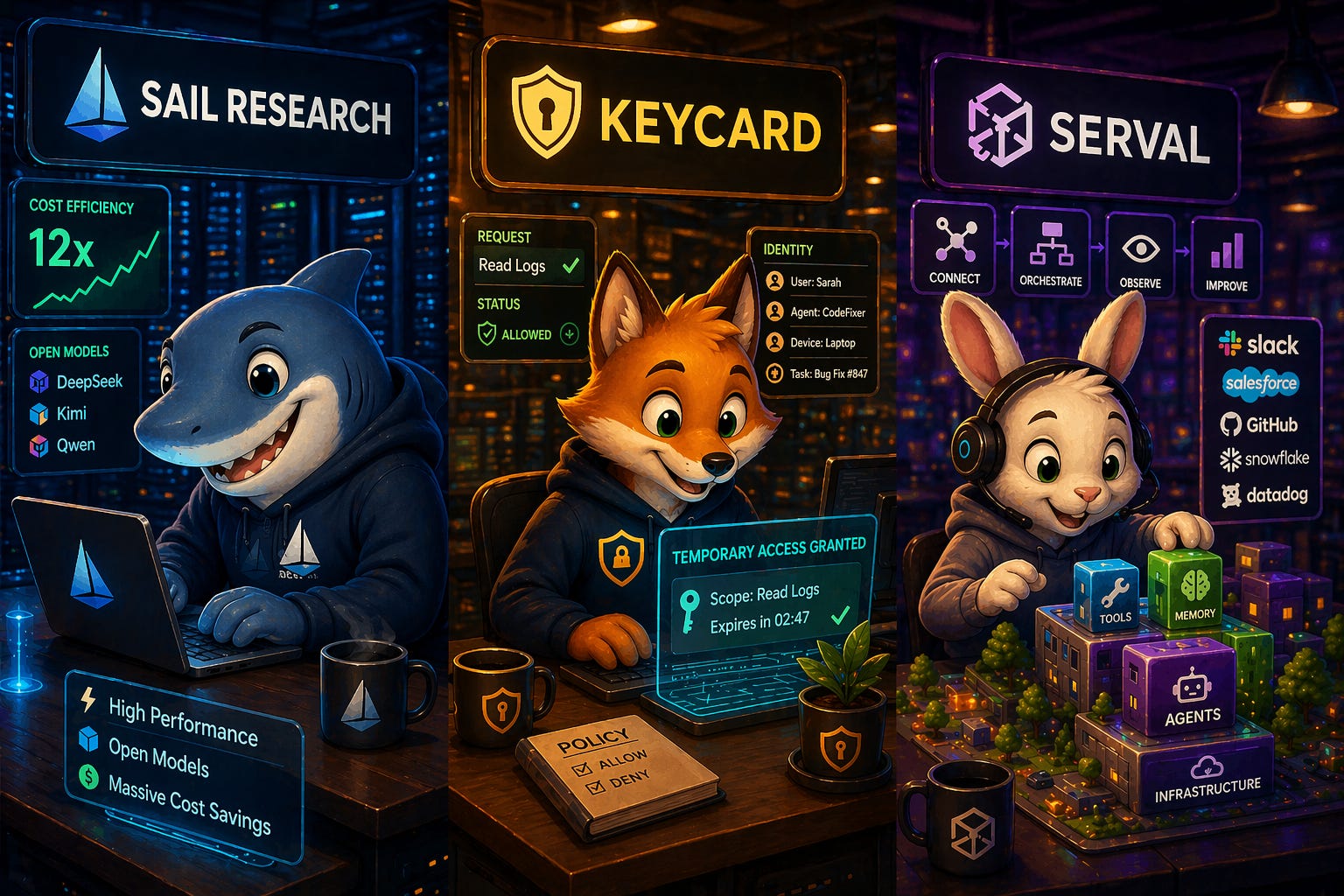
Neil Movva, Co-Founder of Sail Research
Neil Movva graduated from Stanford and spent time at NVIDIA and Apple, where he watched inference bills become the ceiling on what AI agents could actually do. Agents worth building — the ones doing deep research, running overnight code generation, processing data continuously — generate enormous compute bills. So companies don’t build them, or they build stripped-down versions that miss most of the value.
The open-source model ecosystem is competitive with frontier models on most real tasks, but the infrastructure to serve them reliably and cost effectively at production scale is lagging. That’s the gap Sail Research is looking to close.
Sail runs open-source models at up to 12x the cost efficiency of comparable proprietary alternatives and their benchmark performance — 82.4 on GPQA-Diamond — competes directly with existing models. The best part? Their API is OpenAI-compatible and they support leading open source models (e.g., Deepseek, Kimi, Qwen).
Sail is working from several angles, writing CUDA to increase performance on GPUs, maximizing efficiency of inference engines, distributing work, and pivoting between spot compute and reliable compute based on availability. In 2026, agents will be good enough to make meaningful, independent progress on hard problems, given sufficient tokens. Sail research will make sure they can.
Meet Neil at our next showcase to learn more about how his team are planning to dramatically increase intelligence per dollar, and make sure no compute is wasted.
Ian Livingstone, Co-Founder of Keycard
Through his work at Cape Privacy and Snyk, Ian watched enterprises give AI agents access to their most critical systems with no coherent security layer in between. At Cape Privacy, he tackled encrypted machine learning before most teams had figured out that data privacy and AI were on a collision course. He went on to scale Snyk’s developer platform from $30M to $300M in ARR, watching firsthand as engineering teams struggled to connect services and applications together securely. These experiences have led him to his newest problem: AI agents are beginning to operate across every system and organization, and nobody has built the security layer to handle them.
Agents are starting to work in production systems and operate autonomously across organizational boundaries, but the systems for allowing access were built for humans clicking buttons — static API keys, long-lived secrets, point-and-click authentication. None of that was designed for thousands of agents spinning up to complete a task and spinning down seconds later, each needing different permissions and access. Given the quick rise of AI agents, perhaps it isn’t surprising that even Slack and Salesforce ended up with leaks tied to agent vulnerabilities.
Keycard is looking to fix this. It’s a control plane for AI agents that cryptographically verifies an agent’s identity, enforces task-scoped permissions in real time, and maintains a full audit trail — without requiring developers to become security experts to use it. Instead of locking agents to narrow workflows or keeping humans in the loop for every sensitive action, Keycard issues short-lived, context-aware credentials that update dynamically as policies change. Access can be revoked instantly. The system integrates natively with Anthropic, OpenAI, and Microsoft, and Ian’s team is already contributing to the emerging standards (MCP, WIMSE, OAuth extensions for agents) that will govern how models securely connect with external tools and agents.
Ian co-founded Keycard with Matthew Creager, his former colleague at Snyk, and Jared Hanson, the creator of Passport.js and former Chief Architect at Auth0. Investors called it “the Auth0 moment for agent access.” Keycard is backed with $38M from a16z, boldstart, and Acrew Capital.
Learn more about Ian’s vision for the trust layer of the agent economy at our upcoming showcase.
Jake Stauch, Co-founder of Serval
Jake arrived at Serval after years of watching talented IT operators at some of the best-run companies in tech spend their days manually handling helpdesk work that should have been automated years ago. At Verkada where Jake led product, his customers were IT leaders who were motivated and desperate to automate. While these IT leaders loved what Jake was able to provide, it was clear they also wanted more. They were looking for a fix to an age old problem that until now required too many resources to effectively automate: the helpdesk.
Jake and his team developed Serval as the fix. IT teams describe their workflows in plain language, and Serval produces automations that are deployment-ready, traceable, and adjustable all the way down to code. Instead of a bandaid on top of legacy systems, Serval rebuilt the entire IT service management stack from scratch, with its own ticketing, access management, and asset management baked in.
What’s happened in practice has surprised even the founders. Customers haven’t just added Serval to their existing toolkit — they’ve ripped out their old platforms entirely. Automation has spread beyond IT into HR, Finance, Legal, and Engineering, with some teams abandoning dedicated software vendors because Serval handles the job better.
Sequoia, who led the Series B, said the customer conviction they’re hearing rivals what they saw when they first backed ServiceNow.
Join us at the showcase to see how Jake and his team are reworking IT from the ground up.
There’s a pattern across these three worth noting. Sail makes ambitious agents economically viable. Keycard provides the trust layer for enterprises to actually deploy them. And Serval is where that automation finally becomes something a non-engineer can own and operate.
The success of the agentic era won’t rely on the models alone. The tools to effectively deploy agents universally is the other half. Neil, Ian, and Jake are building these now. If you’re an engineer who wants to work on the hardest parts of the problem, this is a rare chance to hear directly from the people defining it.
Apply to attend our next SF Startup Showcase and meet these founders in person.