


🌟 Engineers — want to meet the three founders below? Apply to attend our Jan 28th SF Startup Showcase.
Every industry has friction points: months to design a chip, hardware that never quite works together, satellite images that are mostly noise. These three founders show what’s possible when you remove those bottlenecks and unlock a new wave of innovation.
At our startup showcase on January 28th, we are introducing 10 founders building companies at inflection points. Today, meet three who have faced industry frictions firsthand and are now solving the problems at their source.
Below, learn more about:
Anna Goldie’s frontier lab, Ricursive Intelligence
Peter Morale’s verifiable code translation platform, Code Metal
Vishnu Sridhar’s breakthrough satellite sensors, Matter Intelligence
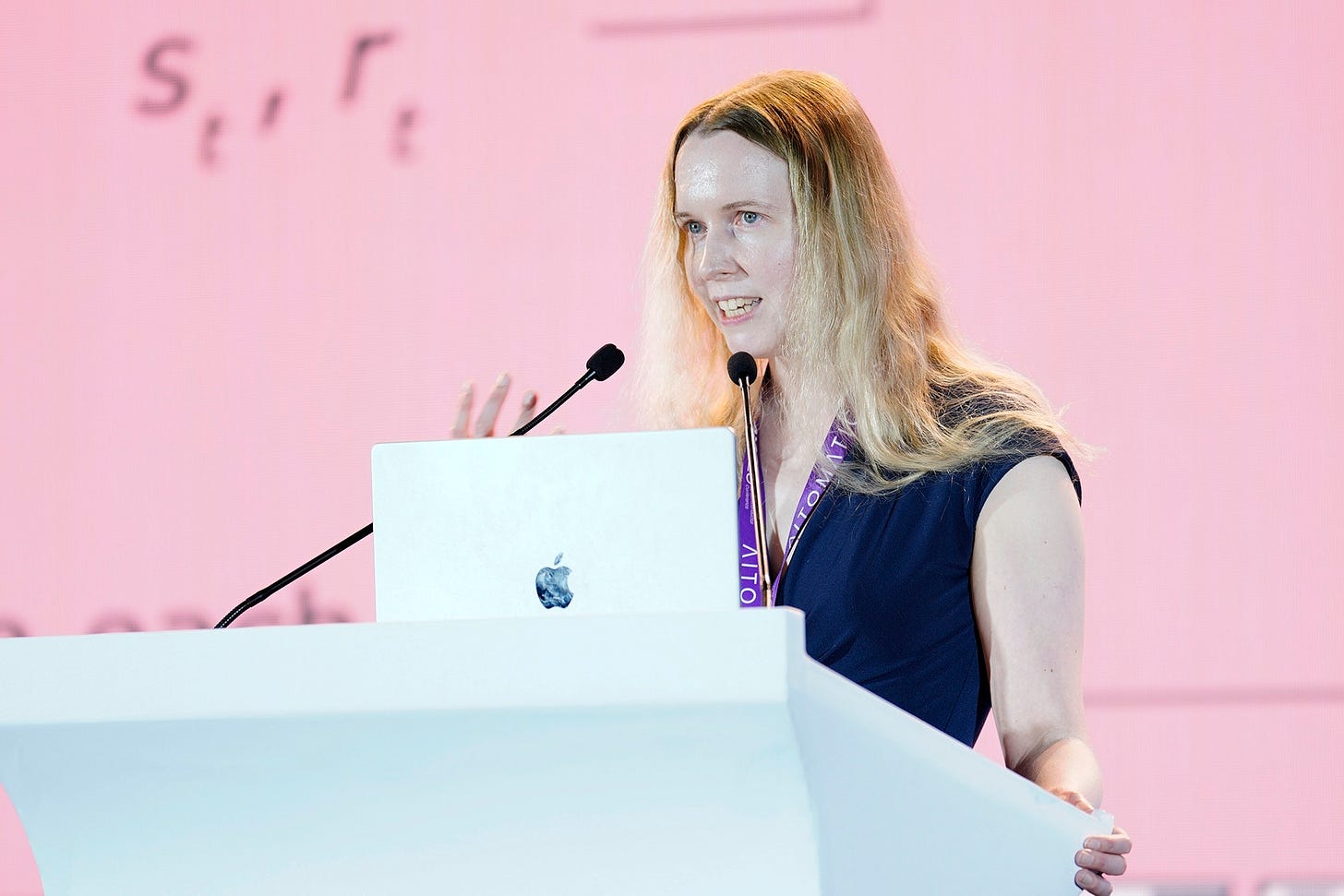
Ricursive Intelligence founder Anna Goldie presenting at the 2025 International Conference on Artificial Intelligence and Semiconductors
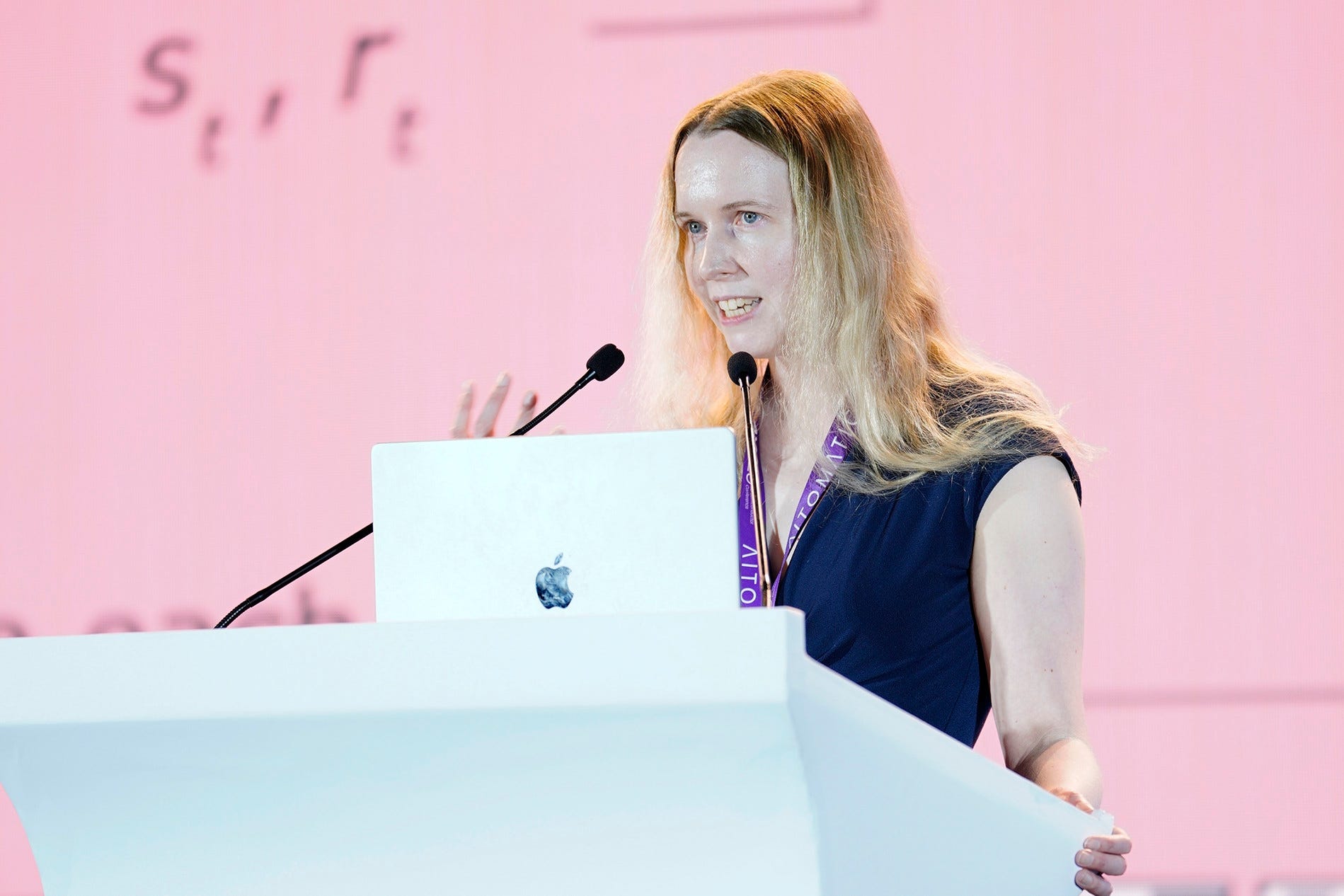
Anna Goldie, founder of Ricursive Intelligence
Anna Goldie has spent her career in places where human intuition breaks down. At Google Brain, she co-led AlphaChip, the system that compressed chip floor planning from months into hours. The RL agents she trained to design chips looked wrong, with strange geometries and unconventional clustering, but the results came back working exactly as predicted, often better than human alternatives.
AlphaChip confirmed a constraint within the industry: AI could move faster if it didn’t take so long and cost so much to translate ideas into hardware. While models improve every quarter, silicon innovates every decade, and the industry quietly agrees to treat graphics GPUs as the long-term foundation for frontier AI.
Ricursive is Goldie’s answer to that mismatch — it’s her new frontier lab built around a simple, aggressive premise: AI should be designing the chips that power AI. Goldie believes teams should be able to describe a workload, specify performance and power constraints, and receive manufacturable silicon without needing to build a massive in-house design organization. The goal is to collapse the iteration loop for custom chips until it starts to feel less like hardware development and more like deploying software.
Ricursive’s team is dense with engineers who have already shipped frontier systems at scale. Beyond Goldie’s co-founder and AlphaChip collaborator Azalia Mirhoseini, the early group includes several engineers who worked directly on AI-for-chip and physical design pipelines inside large labs and tech companies. The team raised a $35M seed round led by Sequoia and are looking to bring on exceptionally talented engineers.
Join us at our next startup showcase to hear Anna Goldie break down her vision and articulate what comes next.
Peter Morales, founder of Code Metal
Peter Morales’ story starts with a drone that couldn’t think fast enough. Asked to take machine-learning algorithms and make them run in real time on flying hardware, he was forced to obsess over deployment paths and edge constraints, not just model design. Throughout his career, this pattern repeated: shipping the same features again and again across wildly different hardware stacks.
Code Metal is his refusal to accept the process of porting algorithms and rewriting code as normal; his deployment pain has gone from a niche problem to a structural issue. The modern hardware edge is a mess: drones, sensors, robots, industrial equipment, appliances, and vehicles all ship with different chips, SDKs, OS primitives, and language ecosystems.
His new startup lets you build for any hardware without rewriting code. The platform allows you to write your algorithms once in familiar research languages like Python, Julia, and MATLAB, and then automatically turns them into code that runs efficiently on a wide range of hardware like CPUs, GPUs, FPGAs, and specialized accelerators.
Morales takes accuracy seriously: Code Metal uses formal methods to verify semantic equivalence between input and output code – it’s not a chat interface that “probably” works, but infrastructure that has to be trusted by defense primes and the U.S. Air Force.
The team raised $35M from Accel last June; Accel’s Steve Loughlin names Code Metal the fastest-growing company in their early-stage portfolio, with “skyrocketing” demand across defense, automotive, semiconductors, and consumer electronics. Current customers include the U.S. Air Force, Raytheon, and several automotive and electronics vendors.
Hear more about Code Metal’s traction from Morales at the showcase.
Vishnu Sridhar, founder of Matter Intelligence
Vishnu Sridhar’s work is literally out of this world – his hardware has traveled millions of miles through space. He was an engineer at NASA’s Jet Propulsion Laboratory, helping build cameras and microphones that landed on Mars and gear for a future mission to Jupiter’s moon Europa. His job was making sure those instruments survived space, worked on arrival, and sent back data you could actually trust about rocks, soil, and ice halfway across the solar system.
Designing instruments for space taught him what good data looks like, and by comparison, why much of today’s satellite imagery of Earth is “basically noise”: it’s too coarse, inconsistent, and incomplete to answer serious questions.
If you’ve ever tried to answer a hard question from satellite pixels, you understand the motivation behind his new startup, Matter Intelligence. Matter is building ultra spectral satellites and models that treat every pixel as a material fingerprint, not just an RGB color. Their sensors, designed for satellites, aircraft, and drones, capture thousands of spectral channels and feed a physics-informed “Large World Model” that can classify materials, track temperature and composition, and spot failures before they’re obvious in standard imagery. Instead of another analytics tool on top of commodity images, Matter is trying to change what the sensor sees in the first place.
Sridhar wants geospatial systems to care about chemistry, not just shapes—so that national security teams can see hidden infrastructure, energy companies can monitor pipelines and power lines for real material degradation, and climate and agriculture models can reason directly over crops, soils, and water quality.
Matter has raised a $12M seed round led by Lowercarbon Capital to build and launch its first satellites like EARTH‑1.
Hear how Vishnu Sridhar is pulling it off at our next showcase.
Want to meet these founders and ones of other breakout startups? Apply to attend our Jan 28th SF Startup Showcase.