


An AI that suggests a command gives you something to review. Give it the ability to execute commands, and it can change a database, restart a service, or overwrite the file you meant to keep. That ability to act is what makes agents useful, but it also creates a new set of problems. Where can they experiment? What are they allowed to touch? And when something goes wrong, will the next attempt be any better?
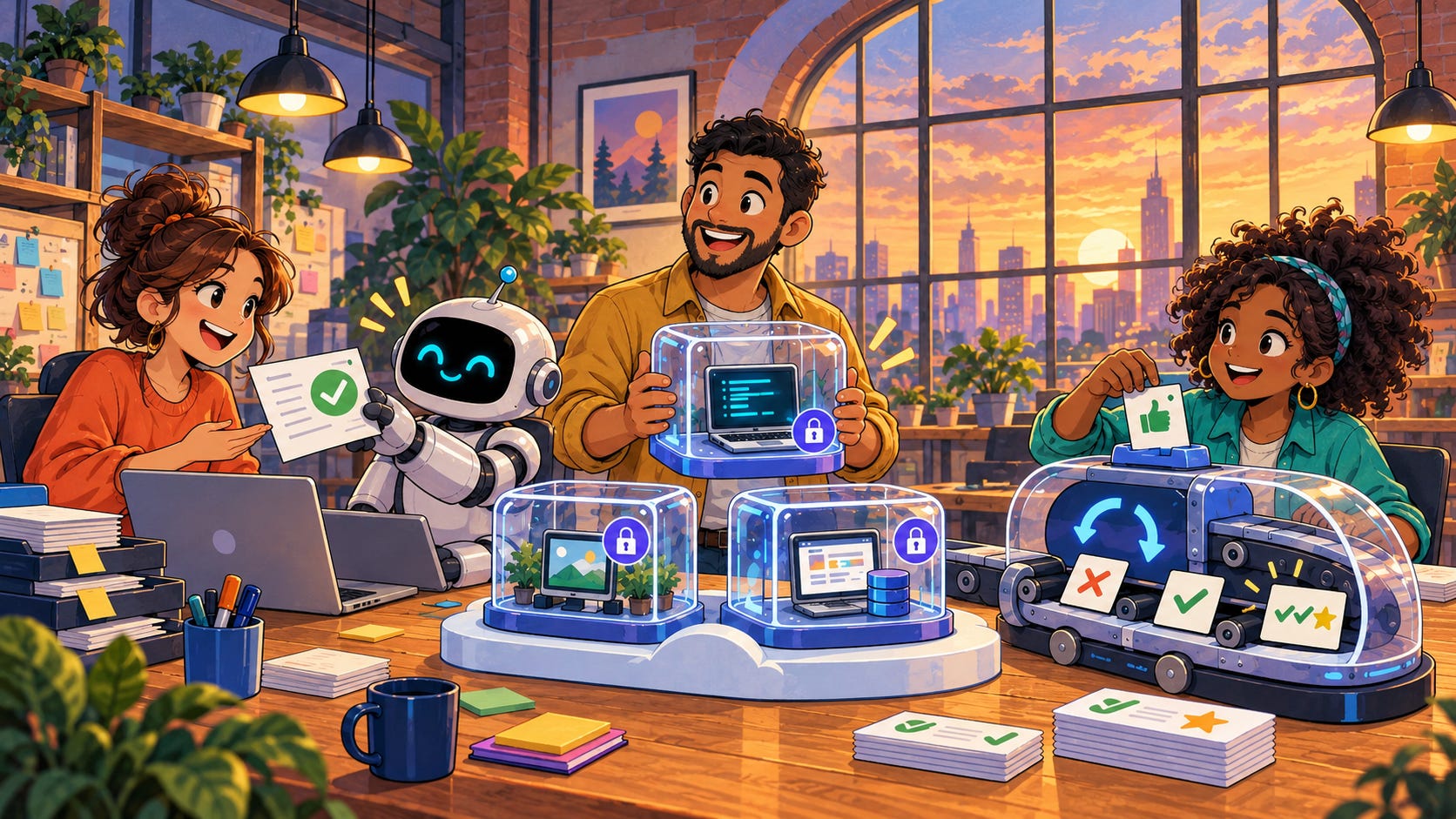
Hone, E2B, and Trajectory are working on different parts of the answer. Hone is building AI teammates that can take responsibility for work. E2B gives agents isolated cloud computers to run code and use tools. Trajectory is building a way for the models behind AI products to learn from real-world usage.
Join us November 18 at OpenAI in San Francisco for our final Startup Showcase of the year. Apply to attend.
Played last week’s lineup guessing game? The answers and our LEGO raffle winner are below!
Moritz Stephan, Co-Founder of Hone
At Cognition, colleagues used to say they needed ‘five more Moritzes’ according to Index Ventures. Moritz Stephan helped build the system that lets Devin plan and carry out coding tasks, then became chief of staff, taking on work across strategy, hiring, and product. The appeal of a colleague like that is easy to understand: you can hand them a difficult problem and trust them to figure out what needs to happen next.
Hone is building AI teammates designed to earn that kind of responsibility. You set a goal and boundaries, and the system learns the company’s processes and the people it needs to work with. For a customer rollout, that could mean tracking down missing information, coordinating handoffs, and following up before the whole thing stalls.
Giving an AI that much responsibility raises an obvious question: how do you know it’s ready? Hone lets teams test its AI teammates, called Engines, against work their company has already done. They can review how an Engine handles past tickets, deals, and decisions, give feedback, and judge whether it’s ready for live work. That puts a substantial engineering problem behind a familiar human expectation: a new colleague should learn how things work and become someone you can increasingly rely on.
Vasek Mlejnsky, Co-Founder of E2B
Vasek Mlejnsky and Tomas Valenta were supposed to be taking a break. In 2023, burned out from their developer-tools startup, they gave themselves two weeks to experiment with GPT-3.5. They built an agent that could run code in their existing sandbox, and the demo took off.
The cloud was built for humans, not agents. While a human chooses and configures the software they want to run, an agent can be writing new code, trying tools, and changing its approach while the job is already underway. You want your agent to have room to experiment. You don’t want it experimenting on the server your customers are using. E2B gives agents their own isolated cloud computers, where they can run applications, work with files, and test what they’ve built.
E2B says 94 of the Fortune 100 have signed up, and more than 100,000 teams are on the platform. That’s a substantial audience for a company whose broader ambition is still taking shape: Vasek envisions a cloud where agents can assemble the tools and computing resources they need as a job unfolds. For engineers joining now, there’s a working platform to build on and a fundamental design question still open: what should the cloud look like when software is doing both the work and the asking?
Ronak Malde, Co-Founder of Trajectory
Every time you fix an AI’s answer, you’re showing it what better work looks like. Whether the underlying model learns anything from that correction is a separate question.
Trajectory is building around that gap. Its approach uses signals such as edits and retries to train the models behind an AI product, with updates evaluated and approved before reaching production. Ronak helped train Windsurf’s SWE-1 coding model before working at Google DeepMind. Now he wants to put model training within reach of product builders. He doesn’t think you should have to assemble an ML team to improve the model behind your product.
The bigger vision is continual learning across the model, its prompts, and the software directing an agent’s work. A product team could use what it learns from its customers to improve the AI itself, without waiting for the next big model release.
Last week’s puzzles, solved 🧩
Thanks to everyone who took a guess at our November lineup! Here’s what each picture was pointing to:
Hone — “Phone” minus the P leaves Hone.
Long Lake — Exactly what it looks like: a very long lake.
Diode Computers — “Die” minus the E, plus an ode and two computers.
Panthalassa — A panther and a lasso: say them together for the sound-alike clue.
And congratulations to Richard Chao, our LEGO raffle winner! Your mini LEGO set will be waiting for you at the November 18 showcase.
Apply to the November 18 showcase to meet these founders in person.