


🌟 Engineers — want to meet ten breakout founders, including the ones below? Apply to attend our Jan 28th SF Startup Showcase.
We’re just a week away from our January 28th startup showcase, where we’ll introduce talented engineers and operators to 10 founders building companies at critical inflection points.
Today, we’re diving deeper into the stories of three founders who will take the stage next week.
Below, learn more about:
David Singleton’s operating system for AI agents, /dev/agents
Joanna Strober’s digital health platform for women’s midlife care, Midi Health
Rhythm Garg’s enterprise-specific AI solution, Applied Compute
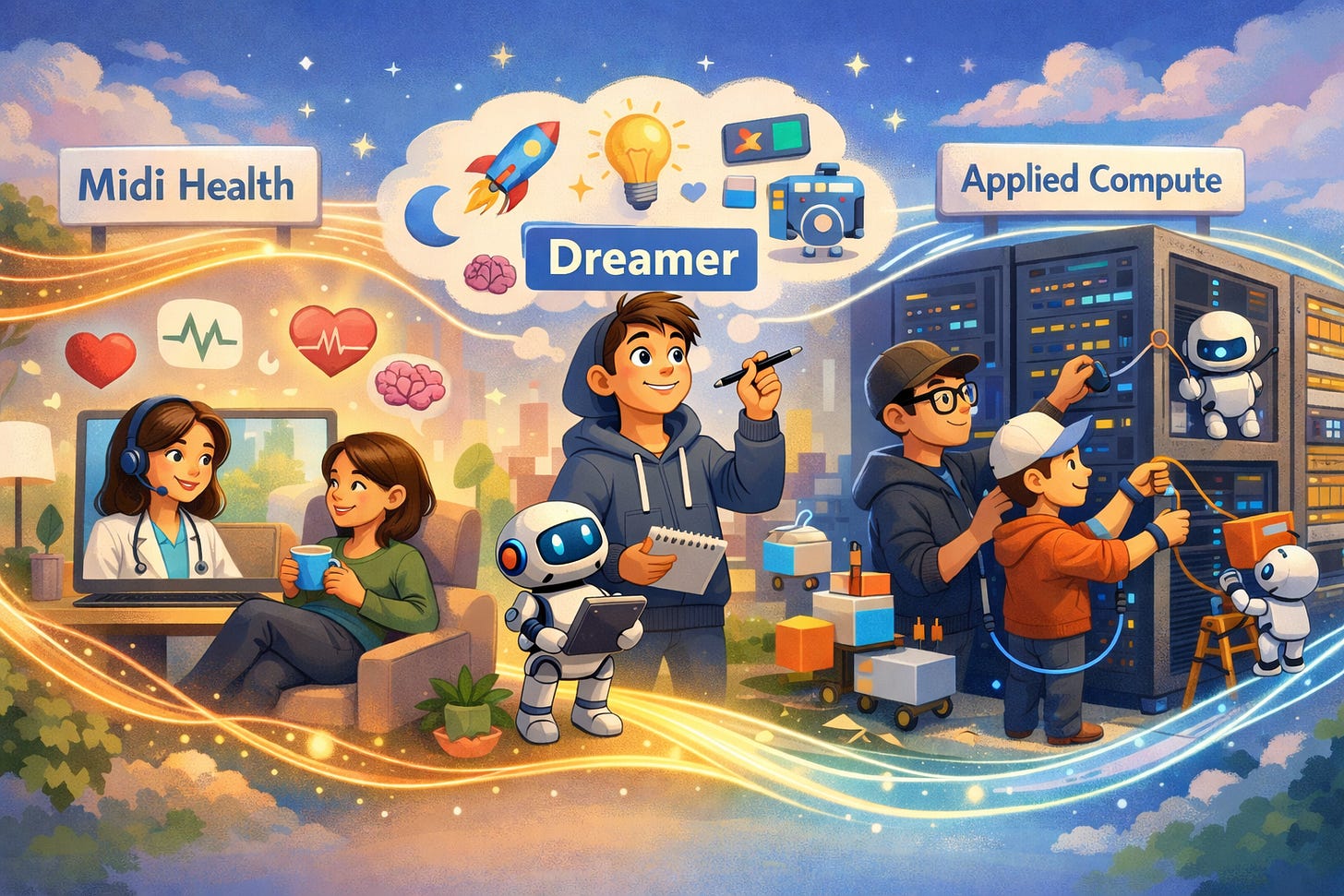
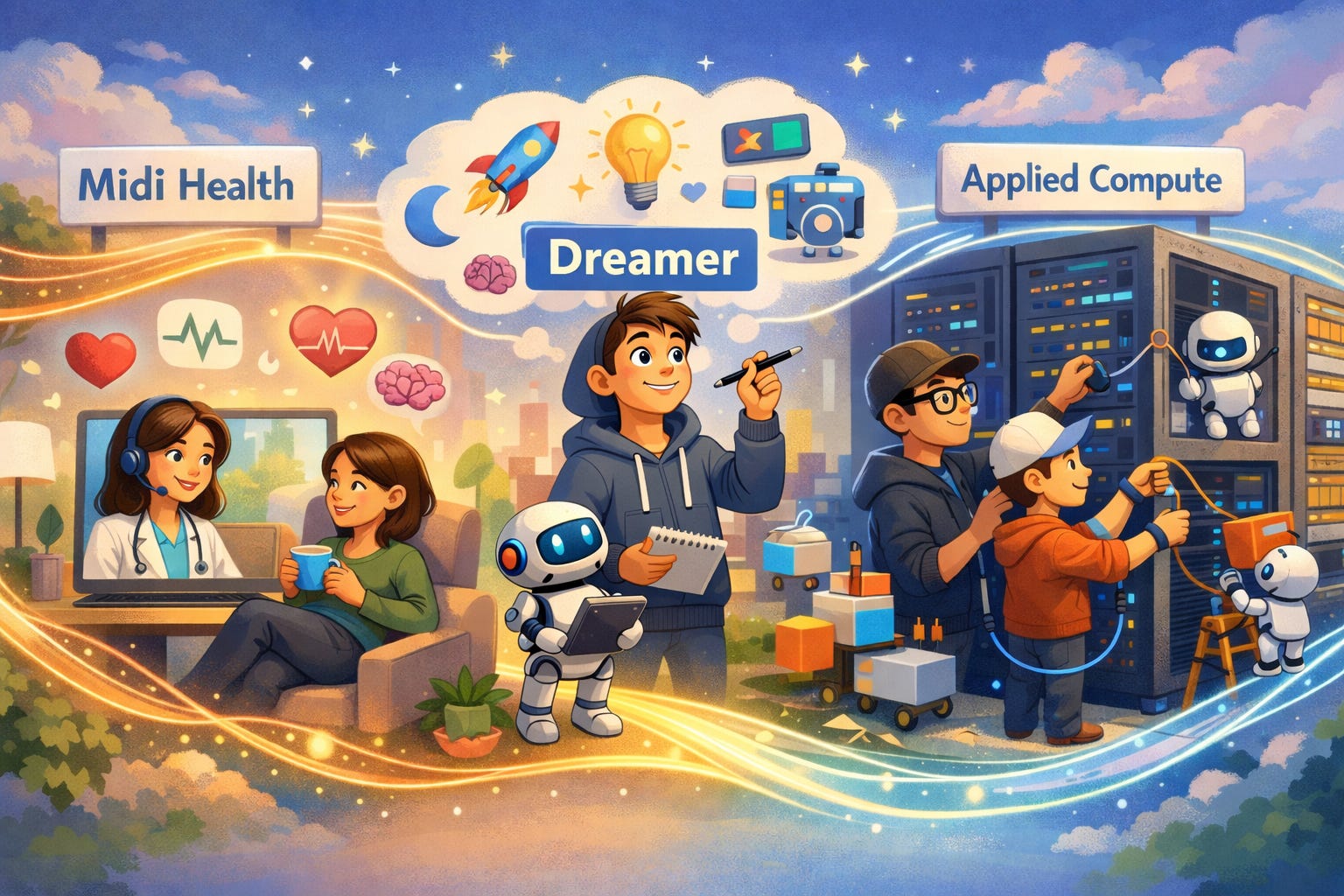
David Singleton, founder of Dreamer
David Singleton has an unusual instinct for timing.
In 2001, he built mobile operating systems at Symbian, recognizing smartphones would become essential before most people owned one. In the 2010s, he moved to Google to lead Android wearables, anticipating the shift from handheld devices to wearable computing. In 2018, he joined Stripe as CTO, ready to tackle payments infrastructure unprepared for the new scale of global digital transactions.
His new startup, /dev/agents, is tackling his fourth bet on a shift in the way we interact with technology: AI agents.
Singleton believes agents are standing at the same precipice smartphones, wearables, and digital payments once did: they’re certain to reshape how we interact with technology, but their full potential requires the right supporting infrastructure. Models are now sophisticated enough to reason, plan, and strategize, but they still struggle with execution. Agents can outline a trip but not reliably book the flight, propose workflows but not coordinate systems, and diagnose failures but not recover from them.
That gap is what Singleton is building toward. His new startup is developing the next-generation operating system for AI agents—software designed to make agents reliable, interoperable, and usable beyond research demos. The goal is also not just more capable agents, but more accessible ones: tools that allow people, regardless of technical background, to build and deploy agents that actually follow through.
His team raised a $56M seed round in late 2024, but the startup is still keeping a low profile. If you want to get the inside scoop directly from Singleton on what he’s building, join us at our showcase.
Joanna Strober, founder of Midi Health
Joanna Strober is a veteran health-tech investor and former founder, and yet she had never heard the term perimenopause until it happened to her. Apparently, her doctors hadn’t either. When she brought her symptoms to clinicians, she cycled through sedatives, psychiatry referrals, and quiet resignation. Not one named what was actually happening.
Her frustrating experience with the healthcare system’s blind spot clarified what she wanted to build next. Enabled by pandemic-era telehealth deregulation, she co-founded Midi Health in 2021 with an all-female team united by shared midlife experiences. The goal was simple but ambitious: turn expert knowledge into clear protocols and deliver insurance-covered care where generalists had failed.
Midi Health is a virtual clinic built specifically for women in midlife, starting with perimenopause and menopause and expanding into broader midlife care, delivered via telehealth and covered by insurance.
In three years, Midi has moved from idea to nationwide infrastructure: insurance‑covered care in all 50 U.S. states, tens of thousands of women treated, and 91% of patients reporting overall symptom improvement within two months of their first visit. The company uses internal protocols and tooling partnerships, including AI‑powered documentation that saves clinicians more than three hours a day, to make high‑touch midlife care operationally and economically viable at scale. Midi has produced meaningful clinical outcomes, like identifying previously undiagnosed osteoporosis.
Midi has raised over $100 million to date from partners at GV and Emerson Collective. The new funding will expand insurance coverage, add 150 clinicians to the roster, and scale the platform to serve more than one million women annually by 2029.
Meet Joanna Strober at our Founders You Should Know showcase to learn how you can be a part of their next phase of growth.
Rhythm Garg, founder of Applied Compute
Rhythm Garg left his role at OpenAI to build a company centered around a strong thesis: the next breakthroughs won’t come from bigger models, but from sharper ones.
His hands-on work scaling o1’s RL reasoning at OpenAI revealed the limits of generalist models on enterprise tasks. His new startup, Applied Compute, is betting that the next wave of enterprise AI won’t be powered by ever-larger generalist models, but by highly targeted systems designed to reason deeply inside a single company’s ecosystem.
Founded last year, the startup is built around what the team calls “Specific Intelligence.” The idea is straightforward but contrarian: instead of adapting generic agents to enterprise workflows, they train proprietary agents directly on a company’s data, processes, and constraints. That means owning the full stack – training infrastructure, agent frameworks, and developer tools – and embedding engineers with customers to build systems that outperform general models on internal evaluations.
The timing matters. Enterprises are less interested in demos and more interested in real impact. Applied Compute’s autonomous agents are already running in production workflows at companies like DoorDash, Cognition, and Mercor, and engineering teams report cutting deployment times from months to days. Benchmark recently raised the company’s $85 million Series B, joined by Sequoia Capital, Lux Capital, and additional strategic backers from the AI and enterprise software ecosystem.
Learn more about how Rhythm Garg and the Applied Compute team are reshaping enterprise AI deployment at our next startup showcase.
Want to meet these founders and ones of other breakout startups? Apply to attend our Jan 28th SF Startup Showcase.