


Want to meet breakout startups like Unlimited? Apply to the FYSK community for invites to our startup showcases, dinners with founders, and more.
If you want to understand why Unlimited Industries exists, you have to start in the middle of nowhere: Seymour, Texas. That’s where Alex Modon was in 2024, building a methanol plant on an empty plot of land. Out there, there are no NIMBYs, no zoning battles, no regulatory gauntlets. On paper, it’s the easiest place in America to build from scratch.
But it wasn’t. It was achingly, painfully slow; a quiet, dragging inertia blocked every single next step. Engineers needed another week. Contractors were waiting on other contractors. Consultants billed by the hour, and behaved accordingly.
Alex was shocked. If this is what building looks like in the simplest part of America, then the problem isn’t just regulation. The problem is a broader, harder-to-fix truth about construction in the United States: we’re not bad at building because it’s hard, but because no one is incentivized to do so. No one is responsible for making it faster, better, and cheaper.
Unlimited is Alex’s attempt to change that. After a decade building software companies, he set out to build a full-stack, AI-native construction company to restore America’s ability to build. In under a year, he’s raised $12M from top investors, assembled a team of seven, and is already working on multi-hundred million dollar real world construction projects powered by a proprietary AI platform. The twist: aside from him and his co-founder, none of them previously knew how to code.
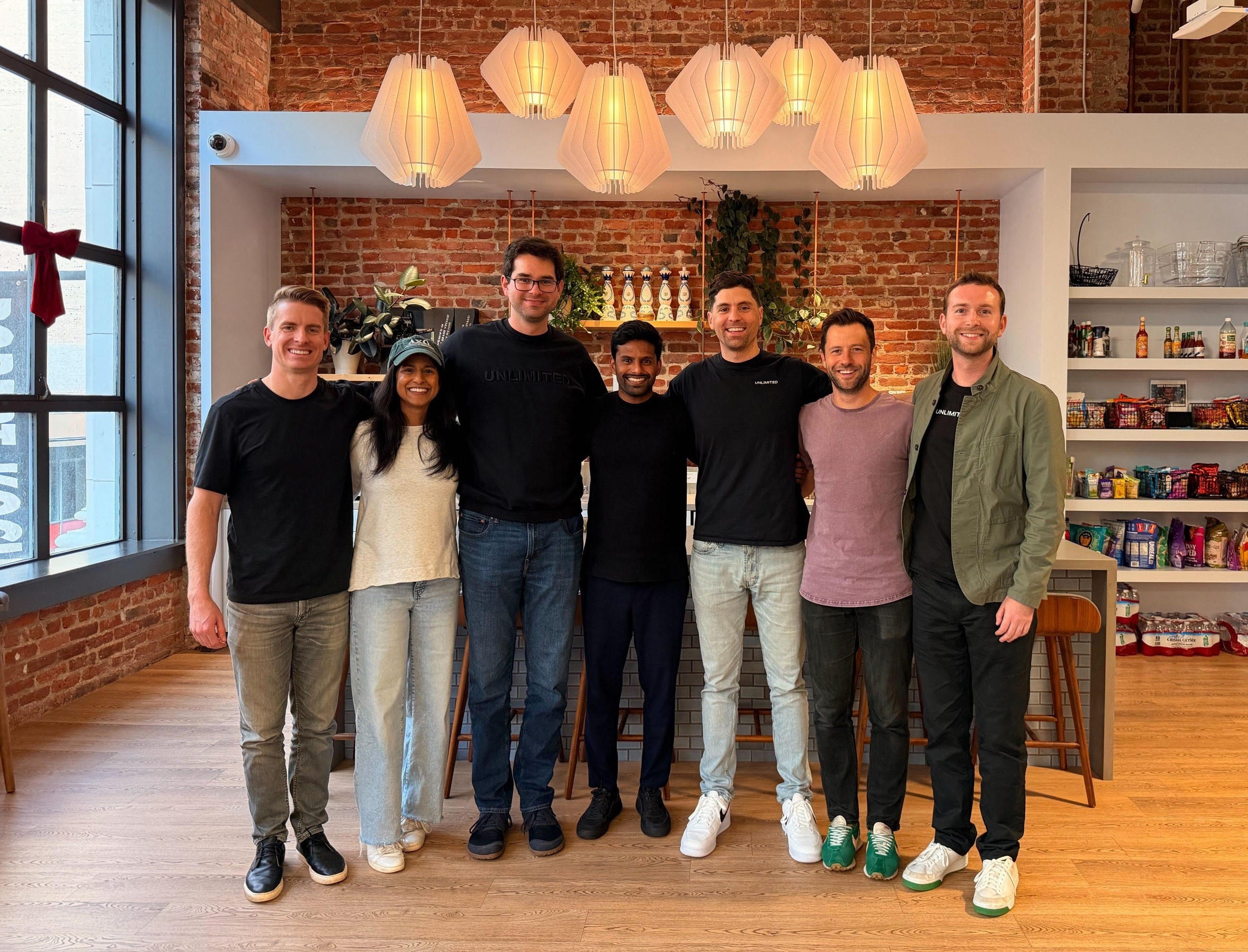
The unconventional team making it work
You wouldn’t guess this team runs hundred-million dollar projects at first glance. They blend into the cozy back corner of another startup’s office, coding, chatting, and avoiding the theatrics of most early-stage teams. But when you look closer at their screens, you pick up on what’s special: for a group that’s almost entirely multi-disciplinary engineers from traditional manufacturing and construction backgrounds, they’re building pretty sophisticated AI tools.
“With our platform, we’re able to build our customers’ construction projects significantly faster and cheaper.” Jordan, the company’s co-founder, tells me. “Until now, they have only known the traditional way of building: slow and expensive. We’re able to reduce the timelines for pre-construction engineering work from months to days for them. They understand the value immediately. And we proved it with just a handful of high agency humans with domain expertise – not your traditional software engineers. This just wasn’t possible without AI.”
It’s an unconventional idea. Instead of building a software tool to sell into the construction industry, Unlimited is full-stack, building everything from the early engineering schematics all the way to the functioning power plant on site. All of this work is made possible by their proprietary AI, and they’re crafting their team around this multidisciplinary approach.
James Betts, the team’s head of projects, was living in Australia with his wife and two kids when he had first learned about Unlimited. For 15 years, he had designed refineries, built oil and gas rigs, and developed hydrogen and mining infrastructure across the globe. He came from the traditional construction world, and knew firsthand how frustratingly difficult it is to build today. When he learned about Unlimited’s goal to rebuild the massive construction industry, he couldn’t say no. He joined the team before the company had even raised money or incorporated.
“When you see the product, you can tell how obviously game changing it is,” James explains. “Every single person I speak to in my world of construction says this is going to change the way we build forever.”
Russ, an engineer on the founding team, spent a decade in industrial and systems engineering leading hundred-million dollar projects before joining Unlimited. So far, his multidisciplinary DNA has been a major advantage towards winning complex customer work; his experience on large capital projects allows him to identify real customer pain points and design solutions that resonate.
“Construction hasn’t had its ChatGPT moment yet.” he says, “Our team gets to show customers magic for the first time. And because we know their world, we can speak to their real problems and build exactly what they need.”
I asked Russ why he left a successful senior engineering career path to build AI-powered products from scratch, something he had never done before. His answer was immediate: ‘This is just a much better way to do things in construction. I am just so excited to be a part of a team redefining how engineering is done.’
Every team member is working in ways entirely new to them, yet in just one year they’ve gone from nonexistent to generating revenue and executing multiple $100M+ real world projects. None of this could have been possible without AI.
“We’re building the tool to build our world,” Alex says, beaming with excitement. He knows what they’re working on will impact the world in a very real way. “If we do this right, you should be able to see our impact on Earth from space. We’re living in a physical world built by our grandparents. Let’s make building ambitious again.”
“Come work with us if you’re excited to work on real infrastructure,” he emphasizes.
Why American infrastructure is stuck
Most Americans don’t realize how broken the system for handling large construction projects is. When a company like NVIDIA builds a data center, they hire a general contractor or EPC firm. These firms often operate under contract structures that reward longer timelines, scope creep, and higher labor usage. Simply put: contractors make more money when projects become more complex, not less. Efficiency is not profitable.
Because of this, engineers on these large projects spend a disproportionate amount of time on clerical and compliance-related work: documentation, design iterations, change-order negotiation, and layers of review required to secure financing and approvals. High-value engineering is buried under process overhead, which drives up labor costs and stretches project timelines even further.
“So many of these projects die because they’re 30% over budget. The IRR doesn’t fit for the investor who’s putting capital into it.” Alex tells me. “That’s a problem that can almost always be solved with a more optimized system.”
Unlimited’s solution is to approach construction like software: break projects into modular components, iterate continuously based on real-time feedback, and use data-driven systems to maximize efficiency and minimize waste. Feed in your project requirements, and their platform generates the globally optimal design. This allows anyone on a construction team, regardless of their engineering expertise, to explore, iterate, and refine.
The team’s early product suite has converted skeptics into die-hard advocates. James tells me about a customer who was openly dismissive of an AI solution from day one. Unlimited changed that.
“A few weeks ago, she texted me just to say that because of Unlimited, she actually enjoys her job again,” he recounts. “Her new role is integrating Unlimited into all parts of the company, and she’s just amazed by what it can do.”
Unlimited could take an easier route. The team could sell their software to existing construction firms, collect enterprise licensing fees, and cash out quickly. Instead, they’re doing something harder: winning large contracts, delivering physical projects, proving the entire model works end-to-end.
It’s not rocket science, but it is a daunting problem to tackle. “This is going to be an incredibly hard company to build,” Alex admits. “That’s okay. We want to fight to win contracts for real projects that need to be built across mining, data centers, and power, deliver on them, and redefine how humanity builds.”
“We’re building a generational company, and we’re going to do it the right way.”
Their vision of abundance
Each team member carries a specific vision of what becomes possible when building works properly.
James fixates on energy: how much cheaper it could be, how many lives that would change. Russ sees the methodology itself spreading beyond infrastructure to sustainable fuels, aircraft, and anything else humans dream to make.
“Everything comes down to infrastructure,” Vardnan, the team’s newest addition, shares. “You can have access to ChatGPT, but if you don’t have public transport to get from your village to school, you’re missing a key part of living a good life.”
Alex’s vision is the most expansive. When you talk to him about his view of the future, you regain a child-like imagination. You remember what it was like when you felt you could build anything.
Today Unlimited is building the data centers and power plants of the world, but what animates Alex is reimagining the physical world we actually inhabit. Your house, your office, the parks where your kids play, “these should all look like the future,” he says.
“There’s no incentive to make things beautiful,” Alex continues. “Building used to be this embodiment of ambition. We need that ambition back in the physical world, so that the thing you’re walking around in is a thing that inspires you.”
Vardnan puts it more simply: “I want to build cities where people can live dignified lives.”
Betting on American ambition
Unlimited is making a bet that seems obvious in retrospect but radical in practice: that the people who understand construction deeply, armed with AI, can revolutionize the industry. That domain expertise plus curiosity plus powerful tools beats pure technical skill.
They’re also betting that America still has the ambition to build boldly. That we haven’t permanently lost the ability to create infrastructure that inspires, captivates, and excites.
It’s early. The team is eight people. The industry they’re trying to transform is measured in trillions, and moves slowly. But they’ve already won projects, converted skeptics, and proven the model works at scale.
What Alex experienced in Texas drives Unlimited today: even the simplest projects can grind to a halt when the system itself is broken. In a world where the most talented people increasingly work on digital ephemera, there’s something refreshing about a team obsessed with the physical world. Success isn’t guaranteed, but they’re asking the question that counts: what if the barrier isn’t invention, but the courage and discipline to better use what we already have?
Inspired to join the team? Unlimited is hiring exceptional engineers across mechanical, electrical, civil/structural, systems & simulation, software — no construction experience required. Join the FYSK community to connect with the team, or apply directly here.