


🍽️ Want to meet Ari & Millen, and other breakout founders over dinner this month? Apply to join the FYSK community and we’ll reach out with dinner invites once we have dates!
Every time you make a phone call, stream a video, or board a plane, you’re depending on an invisible resource. And while over the last few decades we’ve moved from phones the size of a brick to devices in the palm of your hand that can stream orders of magnitude more data, the systems managing that underlying resource have remained unchanged.
Radio frequency spectrum is the medium beneath nearly every wireless signal. There is a fixed, finite amount of it available for different use cases – physics says so. You cannot make more. The system deciding who gets to use it, and when, and how much, was designed in the 1990s, and has barely changed since.
For a while, this was fine; the devices that needed spectrum were few enough that the patchwork held. Then satellites multiplied, drones went commercial, and autonomous vehicles started talking to infrastructure. The number of wireless devices on earth began doubling in ways that made the old growth curves look quaint, and spectrum infrastructure couldn’t keep up.
Millen Anand and Ari Rosner looked at this problem and came to a clear conclusion: this isn’t a policy problem – it’s a software one.
The Founders
Millen is the kind of person who will tell you, with complete sincerity, that he finds radio frequency allocation fascinating. At Planet Labs, he led a new class of Earth-imaging satellites, and the last thing he did before leaving was watch it go up on a SpaceX rocket.
That satellite was connected to Earth for approximately one hour a day. The rest of the time it was unreachable, flying dark, unable to send or receive anything. This is because connecting satellites to Earth requires radio spectrum and ground infrastructure, both of which are expensive and scarce. The industry has accepted this constraint as the cost of doing business in space, built their operations around it, and learned to live with the lag.
His cofounder Ari Rosner came in from a different angle. Ari was employee number two at True Anomaly, a defense tech startup where he wore every hat imaginable and grew the company from a few people in a co-working space to 200+ employees and over $400M raised. He left as Chief Engineer of two of their largest orbital programs.
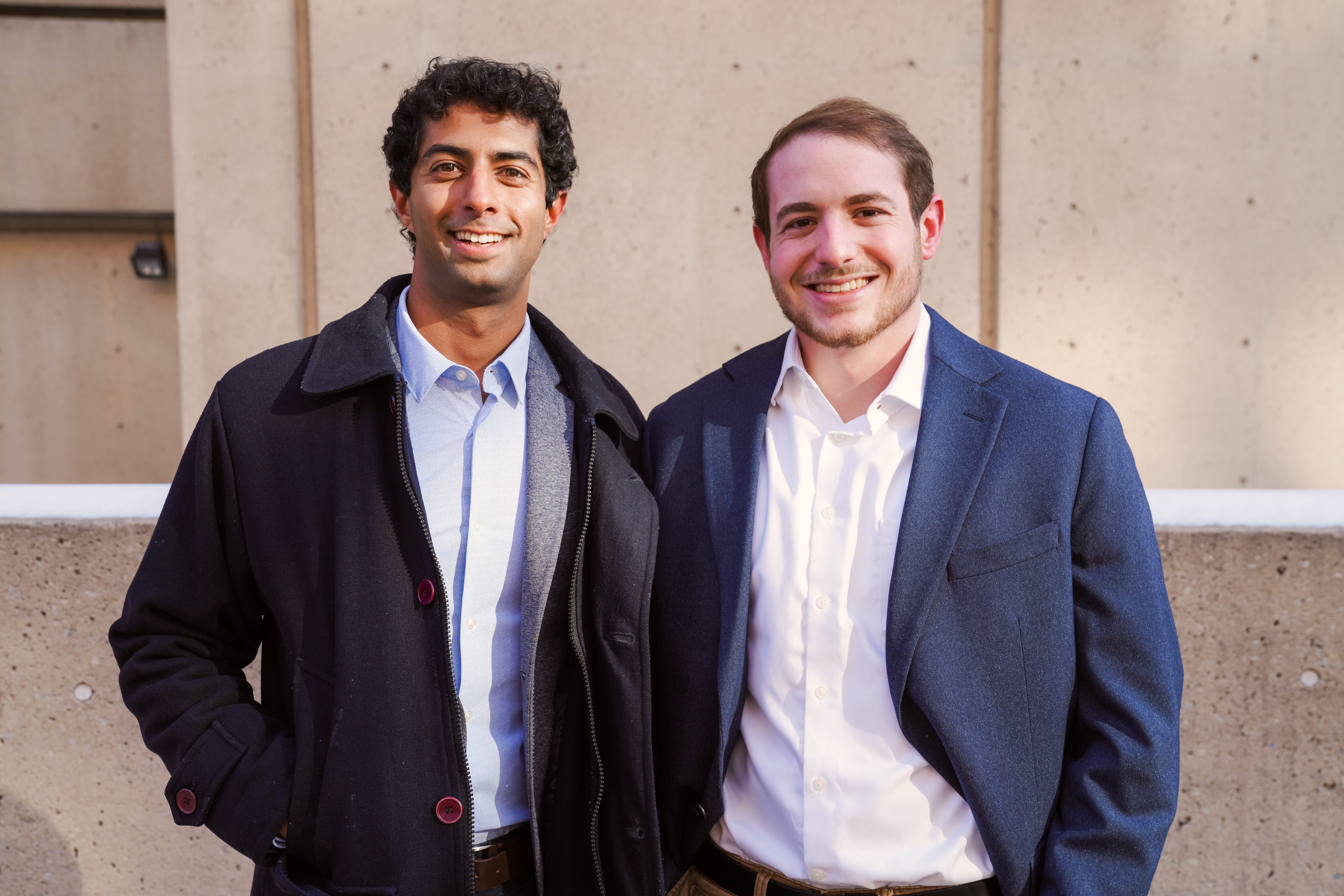
Where Millen’s instinct was to go deep into the technical problem, Ari’s was to translate it: to walk into a room full of non-engineers and deeply understand their pain points and the urgency of the problems they were facing on a day-to-day basis.
Together, they shared two convictions: that the spectrum problem was solvable, and that nobody was seriously building the systems required to do so.
Pitching Washington
Driven by the conviction that the spectrum problem was a solvable software challenge, they came to Washington. What they did not have, starting out, was a company name or business cards. What opened doors was their framing: rather than arriving with complaints, as most industry contacts did, they showed up as engineers who wanted to be part of the solution. And rather than slide decks and vision statements, they showed up with things that worked, hearing about a problem on Friday and returning Monday with a working prototype.
Senior leaders in spectrum cleared their calendars. What Millen and Ari could articulate, in a way no one else had, was that they had a solution that could solve this massive problem, and deliver it in the timeline required to keep up with the exponential spectrum use. The regulators have the domain knowledge. They just lacked software capable of handling the scale and complexity of modern spectrum demand.
The timing is not incidental. A December executive order directed precisely this kind of modernization, the SAT Streamlining Act calls for automated satellite licensing, and the Golden Dome initiative has identified spectrum access as a critical military constraint. For perhaps the first time, policy is pulling in the same direction as technology.
Most companies emerging from stealth arrive with a story about what they intend to do. Last week, Airbase surfaced with something more rare. Instead of talking about what they will go build and what the end-user will be able to do, they’re already doing it. They already have a U.S. Government contract. And already have end-users actively testing their software.
The goal is not to wait. The goal is to have government regulators actively using the product in their daily work, so that the vision is not a promise but a fact.
Who They’re Looking For
Airbase is a team of seven people, and each of them owns something real. There is no orientation period, no ramp-up quarter, no safe lane to travel in while you figure out what you’re supposed to be doing. You will have an impact on day one.
The team is looking for software and RF engineers in New York City to build for customers like the NTIA, the FCC, the U.S. Military, and commercial spectrum users across the land, sea, air, and space domains.
More than any technical specialty, they’re looking for people who see something that shouldn’t work the way it does and can’t help but fix it.
Apply here: https://jobs.deel.com/airbase