


🍽️ Apply here to indicate your interest in the FYSK summer dinner series — We’re still taking applications!
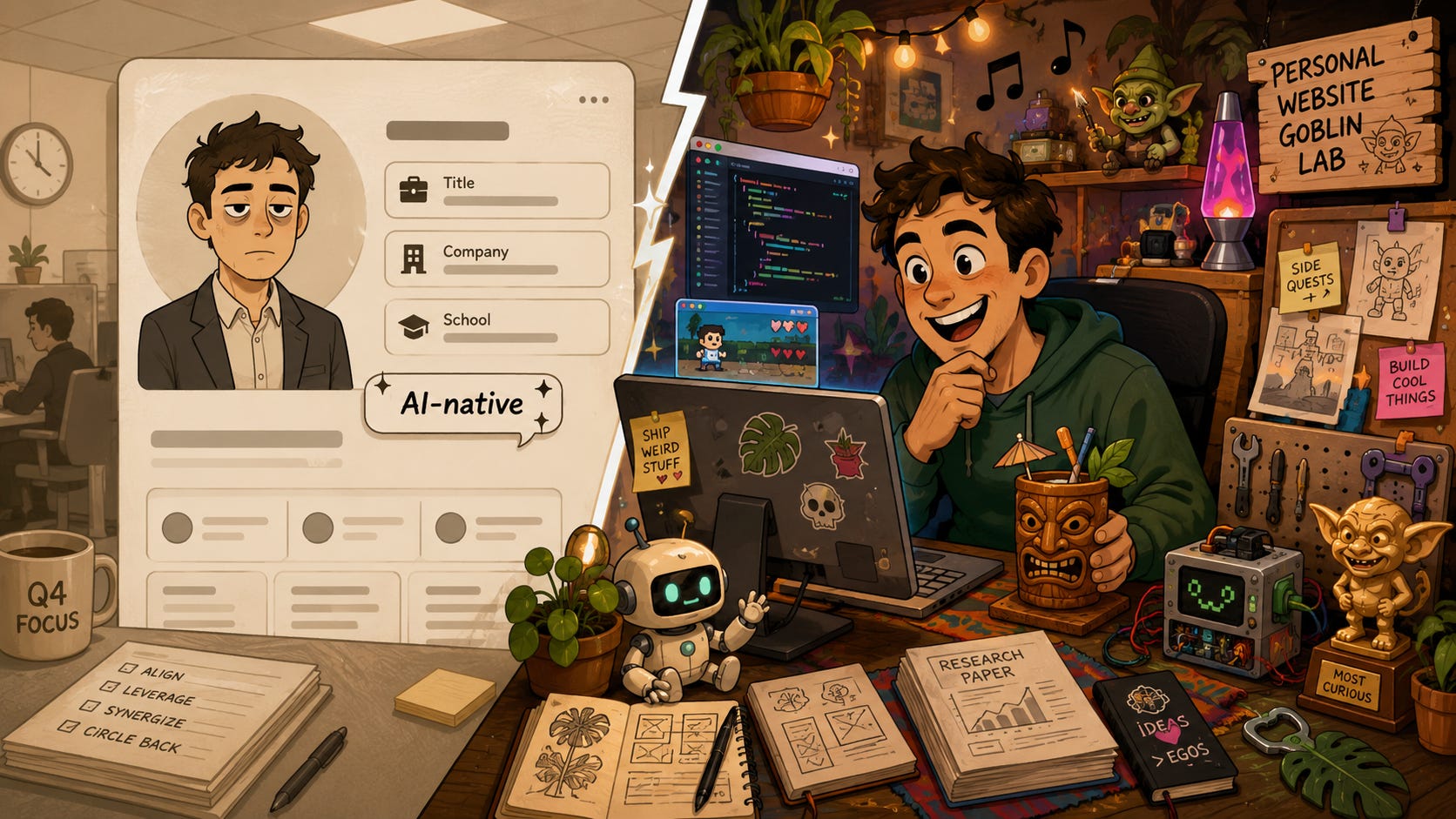
LinkedIn is fine, but personal websites are where the weird good stuff lives. AI has made building easier, which means the bar has moved. The most interesting people now show receipts: projects, writing, design taste, weird obsessions, half-finished tools, thoughtful essays, and GitHub rabbit holes.
That’s part of why personal websites are having a moment in the FYSK community. LinkedIn still has its place. It tells you someone’s title, company, school, and maybe whether they recently discovered the phrase “AI-native.” Helpful and fine. A little beige.
The personal websites we’ve seen show how the creator thinks. The best ones feel less like resumes and more like personal trophy cases: things built, people built with, ideas chased, side quests pursued, and tiny clues that make it clear there’s a human behind the keyboard.
Here are a few we loved:
Bryce Sandlund
Bryce’s site proves he can’t be reduced to a LinkedIn headline. There are research papers, software projects, competitive-programming history, opinions on academia, AI writing, and old projects. There’s also beer brewing, music, and outdoor adventures.
Almost none of this would fit on a normal resume. The research is serious and substantial, but the site never flattens him into “person with publications.” You can follow links into reinforcement learning and AI, explore independently built products, see the competitive-programming community he’s participated in and supported, and then casually discover that he also makes tikis (Bryce if you’re reading this, I want one). The site gives you a much fuller picture of Bryce: not just what he has done, but what he notices, what he builds, and what corners of the internet his curiosity has colonized.
Harsha Karanth
Our favorite part of Harsha’s site is the project section. The work is concrete, clickable, and pleasantly all over the place. There’s Notefolio, an investment journaling platform linked to the App Store. Cardiac AR, which points to research on collaborative mobile AR for cardiovascular surgical planning. There’s also an AI-powered employee onboarding platform with a video demo, an SEC 8-K stock predictor, and a mobile version of Egyptian Rat Screw – which we can only assume is safer for hands than the card-slapping original.
By the time you reach the line “reaching for the stars, one line of code at a time,” the pun feels earned. And for the record, we are pro-pun: Harsha makes a strong case that he is, in fact, a star.
Cooper Shea
Cooper’s site makes you feel like you just dropped into someone’s workshop and realize they have five tabs open in their brain. He’s obsessed with questions around computational design, manufacturing, materials, AI, human cognition, and the messy process of turning ideas into physical things. Then you hit the projects tab and the builder brain fully reveals itself.
There’s a cleft palate orthodontic device for infants with Pierre Robin sequence, built through a Blender, nTopology, and Python pipeline that cut a manual process from 14 hours to 2. Right next to it is a Monstera leaf bottle opener, VR-sculpted in Gravity Sketch and post-processed in Fusion 360. The range is impressive. You get medical devices, aquaculture robotics, hydrogen systems, microneedles, ocean plastics recovery, and houseplant-shaped bottle opener. It’s a very specific flavor of builder energy: deeply technical, physically grounded, and just weird enough to be memorable.
The CV is tucked away at the end. After clicking through projects, theses, writing, and the homepage quiz — which took us way too long, no further questions — you eventually learn Cooper has a Stanford M.S. in Mechanical Engineering focused on Biomechanics and Thermodynamics. By then, the credential lands differently. Like “oh, that explains the houseplant bottle opener pipeline.”
Madhuri Bhavana
Madhuri’s site is a great example of a portfolio that shows not just what the final product looks like, but how the thinking happened. Her work is organized around real product problems: redesigning a complex virtual-machine creation flow at Nutanix, designing Amazon Easy for shoppers in emerging markets, and conducting research for Google’s AdMob platform.
The case studies do what good case studies should do and what many case studies heroically avoid doing: they show the actual judgment. They lay out the problem, users, research, insights, tradeoffs, and concept development alongside the final experience. You can see the difference between someone who can make a clean interface and someone who can make complicated systems more understandable, inclusive, and useful. That’s the real signal.
The best personal websites do something resumes and LinkedIn rarely do. They remind us there is a person behind the page. They show the projects behind the titles, the taste behind the work, the curiosity behind the credentials, and the side quests that make someone memorable.
That’s part of what makes the FYSK community special. Yes, the talent is exceptional. But the real magic is the density of curiosity, generosity, ambition, taste, and “you really built that?” energy in one place.
Thanks again for being a part of FYSK!
Have a personal website you’re proud of? Share it when you apply to the FYSK community!